Lesson Overview
This video, presented by Heidi Naderi (Senior Consultant at Compliant Medical Devices), covers clinical equivalence as defined in Article 61 and Annex 14 of the MDR.
Clinical Equivalence
Clinical equivalence refers to when a manufacturer bases the clinical evaluation of their medical device on clinical data from a separate device—either their own or one from another manufacturer. The goal is to avoid unnecessary clinical investigations by using existing valid clinical data.
Why Use Clinical Equivalence?
While clinical investigations are commonly used to gather data, they are not always necessary. Investigations involve risks, especially when evaluating new or untested devices, materials, or technologies. The equivalence route provides a way to use data from an existing device to support regulatory approval.
Regulatory Requirements for Equivalence
According to Annex 14, Paragraph 3 of MDR, the manufacturer must demonstrate equivalence in three key areas: biological characteristics, clinical characteristics, and technical characteristics.
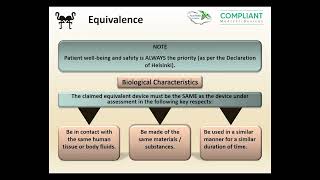
Biological Characteristics
The claimed equivalent device must be identical to the device under assessment in terms of:
✔ Same tissue or body fluid contact.
✔ Same materials or substances.
✔ Similar usage duration and method.
Clinical Characteristics
The claimed equivalent device must be identical or highly similar in terms of:
✔ Same patient population (age, anatomy, physiology).
✔ Same type of user population (e.g., healthcare professionals or patients).
✔ Same clinical condition or intended purpose.
✔ Same site of application (in or on the body).
✔ Similar clinical performance.
Technical Characteristics
The claimed equivalent device must be technically the same as the device under assessment in terms of:
✔ Similar design and principle of operation.
✔ Similar deployment method.
✔ Similar conditions of use.
✔ Similar properties and specifications.
Demonstrating Equivalence
The manufacturer must provide scientific evidence proving the claimed equivalence. Notified Body assessors will expect to see clear, documented evidence that the manufacturer has access to data for the equivalent device.
Example: Wound Dressing
What if a manufacturer wants to claim equivalence between two wound dressings? If the equivalent device has a different clinical claim, it cannot be used as a basis for clinical equivalence. All biological, clinical, and technical characteristics must align for equivalence to be accepted.
Conclusion
Equivalence must be scientifically justified and based on proven access to data. All three characteristics (biological, clinical, and technical) must align for a valid equivalence claim. If equivalence cannot be established, the manufacturer must seek alternative routes for clinical data.