Lesson Overview
This video, presented by Rainié Papadopoulos, explains Corrections, Corrective Actions, and Preventive Actions (CAPA) under ISO 13485.
Common Misconceptions
- Many people incorrectly define corrective actions and preventive actions as:
- Corrective Action: Fixing a problem that has occurred.
- Preventive Action: Ensuring the problem does not happen again.
- These definitions are wrong.
- This video clarifies when to implement a correction, corrective action, and preventive action.
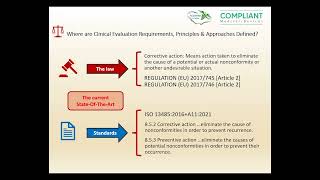
Where Are These Requirements Defined?
- Regulatory Definitions:
- MDR & IVDR (EU Regulations): define corrective action in Article 2.
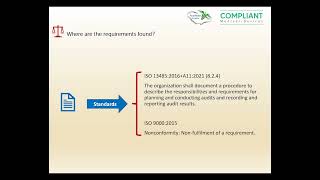
- ISO 13485:2016:
- Clause 8.5.2 – Corrective Action
- Clause 8.5.3 – Preventive Action
Understanding the Differences
- Correction (not the same as a Corrective Action)
- Definition: An action to eliminate a nonconformity, but not its cause.
- Example: A nonconforming product was loaded onto a lorry. The correction is to retrieve and quarantine the faulty product.
- Timing: A correction can be done before, during, or after a corrective action.
- Corrective Action
- Definition: An action to eliminate the cause of a nonconformity that has already occurred, to prevent recurrence.
- Example: The root cause of the nonconformity was insufficient training in the loading bay procedure.
- Corrective Action: Updating the loading bay procedure to include proper training requirements.
- Preventive Action
- Definition: An action to eliminate the cause of a potential nonconformity before it happens, to prevent occurrence.
- Example: Two other procedures were identified where new employees could cause nonconformities.
- Preventive Action: Updating those procedures to ensure new employees do not introduce errors.
Summary of Key Differences
- Correction & Corrective Actions: Address nonconformities that have already happened.
- Preventive Actions: Address potential nonconformities before they happen.
- Corrective Actions: Prevent recurrence.
- Preventive Actions: Prevent occurrence.
- Corrections: Eliminate the immediate nonconformity, while corrective and preventive actions eliminate the root cause.
- There can be more than one cause for a nonconformity or potential nonconformity.