Lesson Overview
This video, presented by Richard Tully (Director of Compliant Medical Devices), explores a procedural approach to defining a severity scale for risk management, ensuring compliance with EN ISO 14971.
- A well-defined severity scale ensures clarity and consistency in risk assessment.
- The scale must be appropriate to the device and understood by the entire risk team.
- Risk teams are multidisciplinary, typically including members from design, production, quality, regulatory, and clinical teams. Additional roles, such as installation, servicing, and post-market surveillance, may also be involved.
- A common risk language helps prevent misunderstandings during risk analysis.
Importance of Defining Severity in Risk Management
- ISO 14971 is the harmonised risk management standard for medical devices.
- Technical Report (TR) 24971 supplements ISO 14971, providing implementation guidance.
- Each medical device requires a risk management plan, which includes severity planning.
Regulatory Background
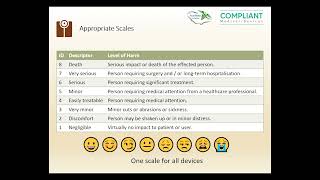
- Severity of harm is typically visualised as a sliding scale from negligible harm to death.
- Zero harm is not a valid descriptor—if something is classified as a hazard, it must have the potential to cause harm.
- Large manufacturers often use scales with up to 10 levels, attempting to cover all possible harm gradations.
- The problem?
- Ambiguity in defining intermediate levels leads to debates and inconsistencies.
- Differences between severity levels are subjective and open to interpretation.
- The only measurable anchors are death (most severe) and negligible harm (least severe).
Understanding Severity Scales
- Instead of using a generic severity scale, the video suggests defining device-specific severity levels.
- Example: Syringe Severity Scale
- Negligible Harm: A cracked syringe causes a delay in treatment, but the healthcare professional simply uses another syringe.
- Minor Harm: A syringe seal failure leads to an underdose and a mess to clean up, requiring the healthcare professional to estimate the remaining dose.
- Serious Harm: A discarded syringe could cause a cut or a fall.
- These three levels are clear and directly tied to the device’s risks, reducing ambiguity.
- Example: Syringe Pump Severity Scale
- Negligible Harm: A delay while the healthcare professional programs the device.
- Serious Harm:
- Using a syringe of the wrong diameter with a critical drug could have severe consequences.
- Missed key presses could result in an underdose, leading to ineffective treatment.
- Bruising from a misplaced needle or power cables obstructing the patient area.
- The complexity of the syringe pump necessitates more severity levels than a simple syringe.
Benefits of a Device-Specific Severity Scale
- Ensures clarity: The whole risk team understands the scale because it is based on real-world device examples.
- Minimises debates and inconsistencies:
- Instead of arbitrary definitions, severity levels are directly linked to the device’s risks.